The topic of the last post was the Council of Trent's rules on prohibited books. These outlined the different categories of works which would need to be placed in the Index for various reasons, whether heretical, blasphemous, immoral or whatever else. This post looks at a number of specific authors whose work (in part or in whole) was put on the Index for a multitude of reasons, many not particularly obvious. One which I personally find inexplicable is Pierre Larousse's Grand Dictionnaire Universel du XIXe siècle. Quite why a dictionary of the French language should require banning I have no idea, especially since the ban remained in force till the end. Perhaps some of the definitions had heretical or blasphemous phrasing, or perhaps some of the words included were themselves considered heretical. The complete list for the 1948 edition can be seen at this site http://www.cvm.qc.ca/gconti/905/babel/Index%20Librorum%20Prohibitorum-1948.htm, but as the forms of the authors names are generally (and logically) latinised, it can be hard to recognise some of them. However, here is a selection from the various editions of the Index.
The Scientists: Galileo Galilei, Nicolaus Copernicus
 |
| Title page and frontispiece of Galileo's Dialogo |
The Philosophers: Immanuel Kant, David Hume, René Descartes, Jean-Paul Sartre
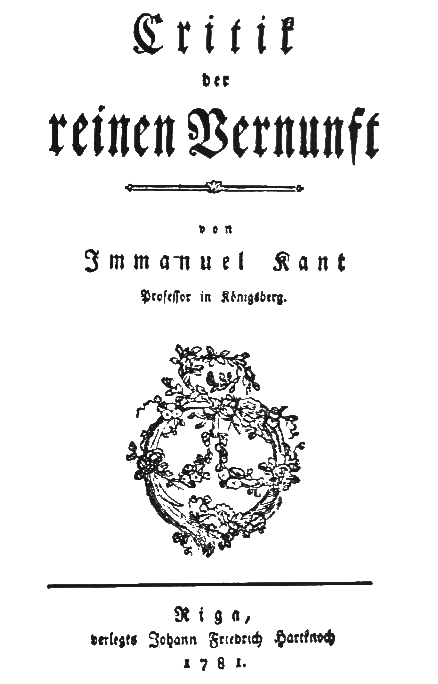 |
| Title page of Kant's Critique of Pure Reason |
The Writers: Victor Hugo, Voltaire, Gustave Flaubert, Émile Zola, Heinrich Heine, Daniel Defoe
Voltaire had a large number of his works in the Index, including among many others, Candide, Le siècle de Louis XIV and Histoire des croisades. Four of Heine's works and one of Defoe's are in the Index for 1948, while Zola's entire corpus was banned. Victor Hugo's Notre dame de Paris and Les misérables, and Flaubert's Madame Bovary and Salammbo were also in the 1948 Index. These are only a small selection of works of great literary merit included in the Index, by authors whose names I hope are recognisable to all.
Commentary
This post is of course not even remotely exhaustive, but I wanted to present well-known and exemplary writers whose works, in whole or part, were in the Index. There are various places that give information on the topic, but the references given are those I ended up using. For more comprehensive coverage, there are other places which people may like to have a look at. This site http://www.aloha.net/~mikesch/ILP-1559.htm is of a facsimile of the 1559 Index.
References
The first two were the sources for most information given above; the Wikipedia article was the source for the paragraph on the scientists, as the information was not readily available elsewhere.
Halsall, P c1998, 'Index librorum prohibitorum, 1557-1966', Modern History Sourcebook, viewed 21 May 2011: http://www.fordham.edu/halsall/mod/indexlibrorum.html
'Index Librorum Prohibitorum -- 1948', Tour de Babel, viewed 21 May 2011: http://www.cvm.qc.ca/gconti/905/babel/Index%20Librorum%20Prohibitorum-1948.htm
'List of authors and works on the Index Librorum Prohibitorum', Wikipedia, viewed 21 May 2011: http://en.wikipedia.org/wiki/List_of_authors_and_works_on_the_Index_Librorum_Prohibitorum
These two are sources of the images:
'Critique of Pure Reason', Wikipedia, viewed 21 May 2011: http://en.wikipedia.org/wiki/Critique_of_Pure_Reason
'Dialogue Concerning the Two Chief World Systems', Wikipedia, viewed 21 May 2011: http://en.wikipedia.org/wiki/Dialogue_Concerning_the_Two_Chief_World_Systems

No comments:
Post a Comment